
How to Tell If Onyx and Gemstone Jewelry Are Real Stone
a field guide · authenticity
Made by earth. Shaped by hand. Kept by you.
Most "stone" décor sold today is resin. Most "gemstone" jewelry sold today is dyed glass, reconstituted powder, or plastic. Both are engineered to photograph like the real thing and to cost a fraction to make. The difference is easy to feel once you know what you are feeling for. This guide walks through what onyx actually is, how to separate real stone from imitation at home, and how to read a gemstone bead before you buy.
The short answer: Real onyx is heavy, cold to the touch, and glows when you hold it to light — and no two pieces share the same veining. Resin is light, warms quickly in your hand, and repeats the same pattern across "identical" items. For gemstone jewelry, real stone stays cool, carries small natural inclusions, and shows uneven color; dyed glass and plastic feel warm, look flawlessly uniform, and often reveal dye pooled in the drill holes.
What is onyx, exactly?
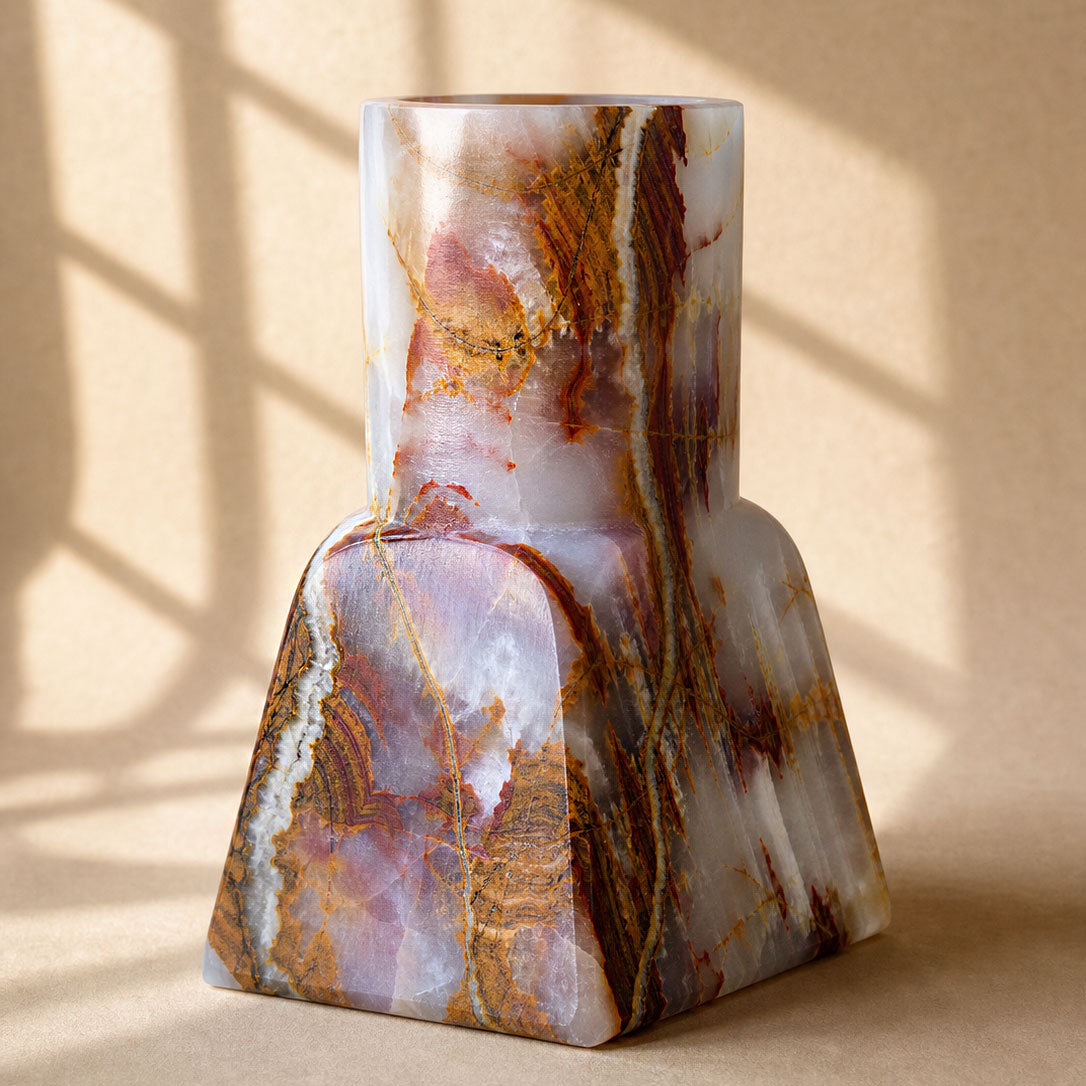
Onyx is a natural banded stone, a variety of layered calcite and chalcedony formed over long geological time as mineral-rich water deposited thin layers, one over the next. Those layers are the bands and veins you see running through a finished piece. Because the layering happens once, in one place, under one set of conditions, every block of onyx is unlike every other. No two veins run the same.
That single fact is the fastest authenticity test there is. A resin or "marble-look" object is cast from a mold, so a run of them shares the same swirl in the same spot. A real onyx object cannot be duplicated, because the Earth only made that pattern once.
Real onyx vs. resin: 5 tests you can do at home
You do not need a lab. You need your hands and a window.
1. Weigh it
Pick it up. Natural onyx is dense and surprisingly heavy for its size — a small vessel can run several pounds; a side table can pass fifty. Resin and cast composites feel hollow and light by comparison. Weight is the first thing a fake cannot fake.
2. Feel the temperature
Real stone pulls heat from your hand and stays cool for a long moment before it warms. Resin and plastic feel room-temperature immediately and warm almost instantly. Rest your palm flat on the surface for a few seconds: stone answers cold.
3. Hold it to the light
Onyx is translucent. Held against a window or a lamp, real onyx glows — light travels into the stone and lights the veins from within. Most resin is opaque or glows evenly and artificially, with no internal structure to catch the light.
4. Read the veining
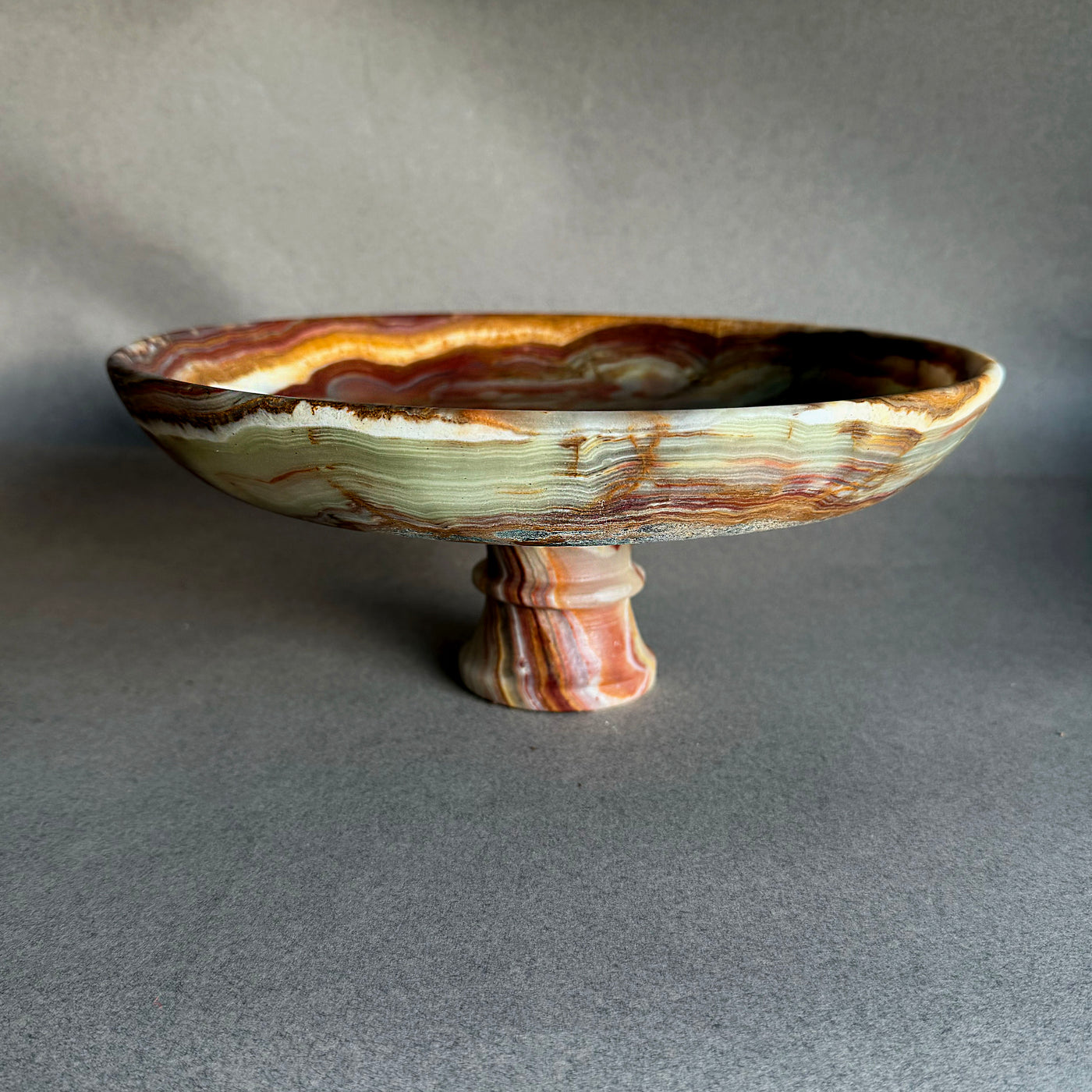
Look for asymmetry. Natural veining wanders, thins, pools, and stops without logic — it never mirrors itself perfectly. Printed or molded patterns tend to repeat, align too neatly, or show a faint seam where the mold closed. If two "stone" pieces in a set are identical twins, they are not stone.
5. Check the edges and underside
Turn the piece over. Real carved stone shows tool marks, a raw or matte-finished base, and slight variation in thickness. Resin often has a perfectly smooth mold line, a poured seam, or a suspiciously uniform base. On a genuine piece the imperfection is the proof.
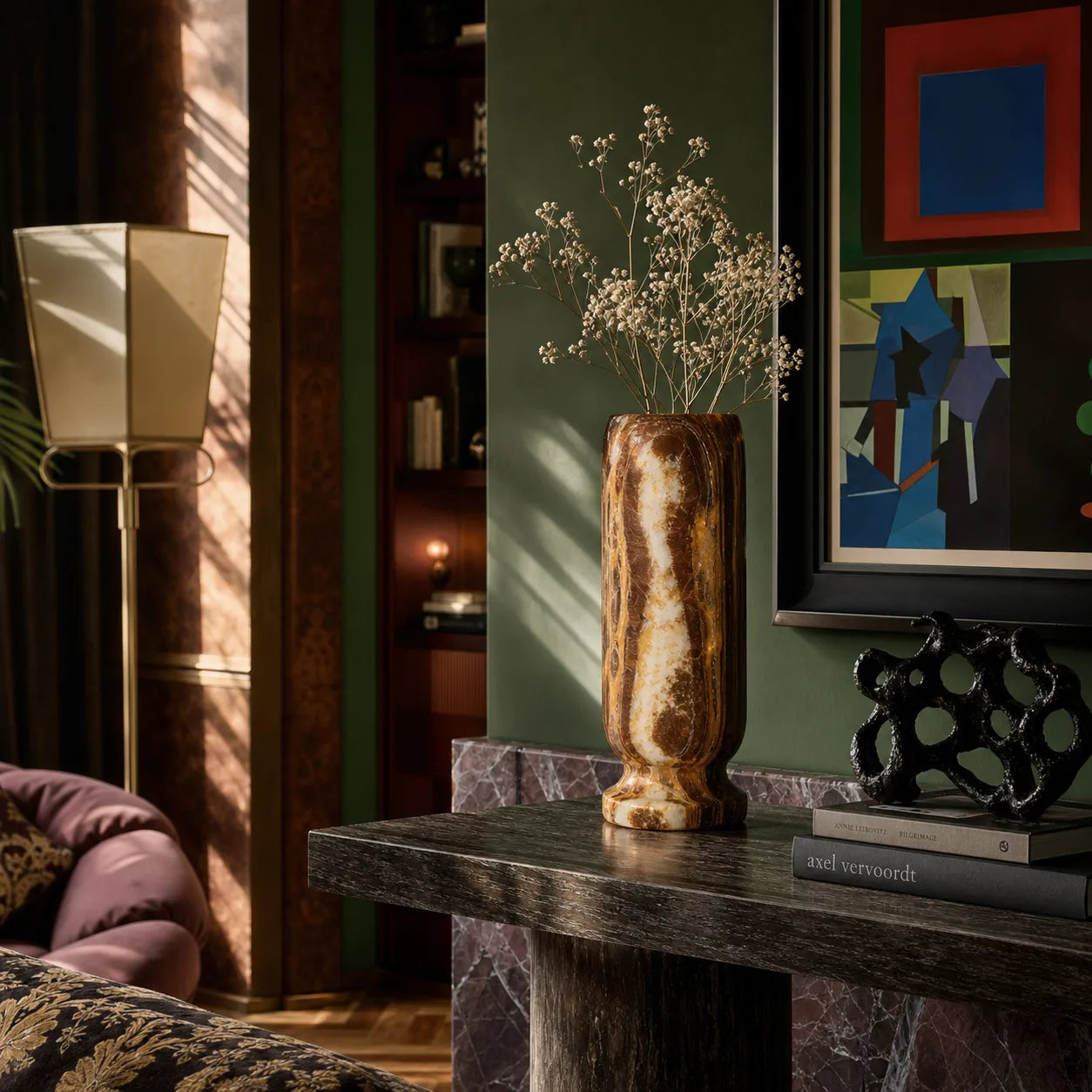
How SAÉA décor is made: Every SAÉA vessel, vase, tray, and bowl is hand-carved from raw, natural onyx sourced small-batch from the quarries of Balochistan, Pakistan, then finished in our San Diego studio with nothing but food-grade beeswax. No resin, no composite, no synthetic polish. See the onyx vessels →
Is onyx the same as marble?
No, though they are often confused and sometimes sold interchangeably. Both are natural stone, but they form differently and read differently. Marble is metamorphic — limestone recrystallized under heat and pressure — and tends toward a cloudier body with fine, dispersed veining. Onyx is a banded, layered deposit and is usually more translucent, with bolder ribboned veins that glow when lit. If a piece lights up from within when you hold it to a lamp, you are almost certainly looking at onyx rather than marble. Neither should be confused with "marble-effect" resin, which is neither.
How to tell natural gemstone jewelry from dyed or glass beads
Beaded gemstone jewelry is where imitation is most common, because a strand of dyed glass or plastic can be made to look like almost any stone. The same instinct applies — real stone is cool, weighted, and imperfect — with a few extra checks specific to beads.
Temperature and weight
Roll a few beads in your hand. Natural stone stays cool and has a small, satisfying heft. Glass warms slower than plastic but faster than stone; plastic feels weightless and warm almost at once.
Look for honest imperfection
Real gemstone beads carry tiny inclusions, cloudy spots, natural color shifts along the strand, and slight size variation. A strand where every bead is a flawless, identical, saturated color is usually dyed glass or reconstituted stone (real powder bonded with resin). Uneven is the tell that it grew rather than got manufactured.
Check the drill holes
This is the fastest bead test. On dyed stone and glass, color often collects darker inside or around the drill hole, and dye can rub off onto a damp cotton swab. Natural, undyed stone shows consistent color straight through the hole.
Know your stones
A few natural markers worth recognizing: tiger's eye shows a moving band of light (chatoyancy) that shifts as you tilt it; moonstone has a floating blue-white sheen that appears and disappears with the angle; obsidian is natural volcanic glass, so it can be warm-fast but shows conchoidal, shell-like fractures rather than mold seams; real freshwater pearls feel faintly gritty against the edge of a tooth, while glass "pearls" feel perfectly smooth. Painted plastic pearls chip at the drill hole.
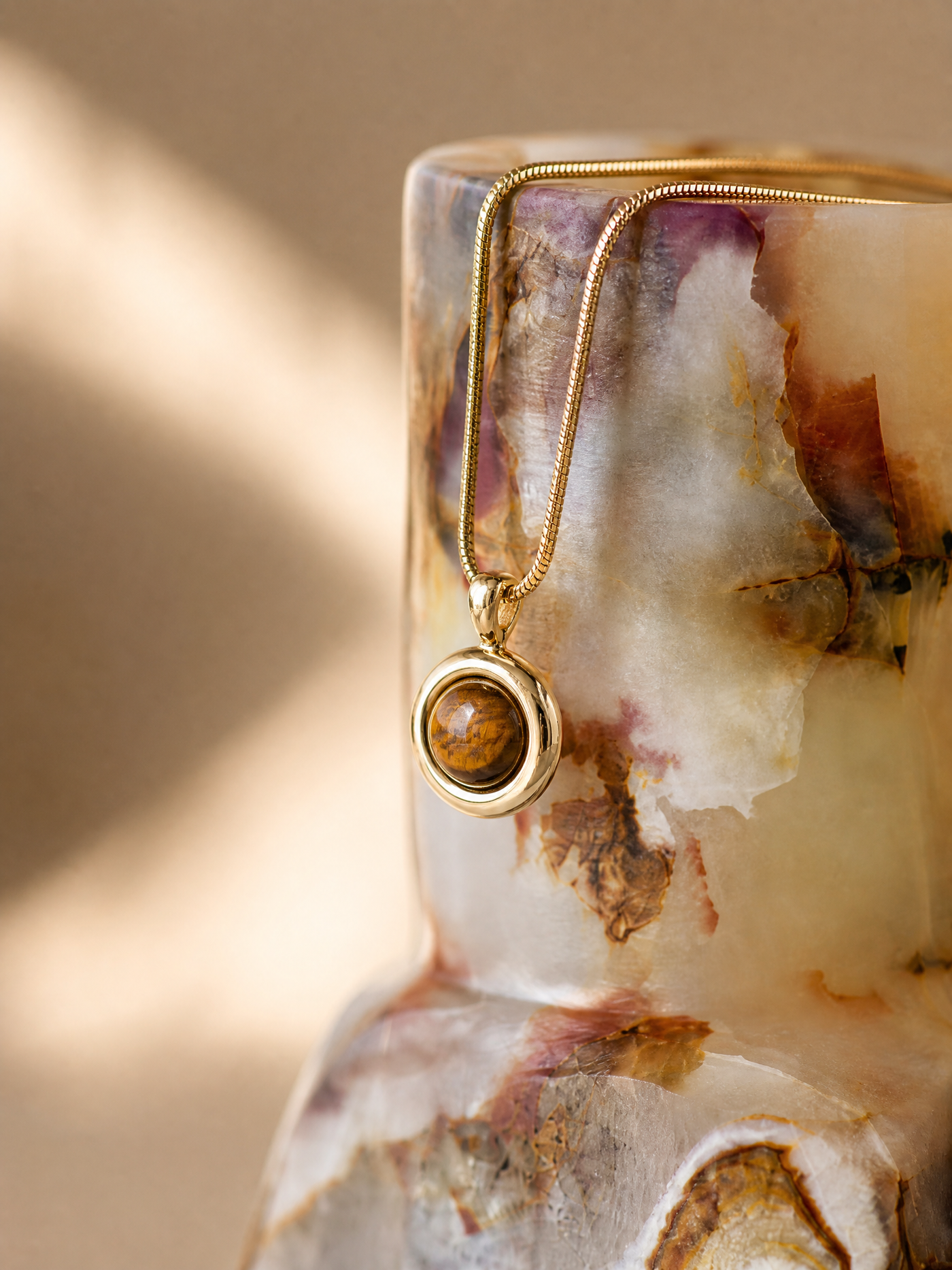
How SAÉA jewelry is made: SAÉA jewelry is designed and handmade by our founder in San Diego, using natural gemstones and materials — moonstone, jasper, obsidian, tiger's eye, freshwater pearl — set alongside gold and silver. Each piece is made in small batches, so the stone variety and character carry through. Real stone, real pearls. Explore the jewelry →
Why authenticity is worth the weight
Real stone costs more to source, more to carve, and more to ship, because it is heavy and slow and cannot be poured out by the thousand. That is the point. An object made of real material holds its value, ages instead of degrading, and stays entirely yours — no coating to flake, no print to fade. It is heavy, it is slow, it is real, and that is exactly how you know.
A resin vase looks like the photo on day one and looks like plastic on day five hundred. A carved onyx vessel is a piece of the Earth on your table that will outlast the room it sits in. The premium is not for the look. It is for the truth of the material.
How to care for real stone
Natural stone asks for tending, not maintenance. Wipe décor with a soft, dry or barely-damp cloth; skip harsh cleaners, which can etch the surface. Keep onyx off direct, prolonged heat and standing water. For gemstone jewelry, take it off before showering, swimming, or sleeping, store pieces separately so harder stones do not scratch softer ones, and wipe beads with a dry cloth after wear. Cared for simply, stone lasts across generations.
Frequently asked questions
Is onyx a real stone or man-made?
Onyx is a genuine natural stone — a banded variety of calcite and chalcedony formed over geological time. Be careful with "onyx-look" or "marble-effect" décor, which is usually resin cast to imitate it. Real onyx is heavy, cool to the touch, and translucent when held to light.
How can I tell if onyx is real at home?
Use five quick checks: weight (real onyx is dense and heavy), temperature (it stays cool before it warms), translucency (it glows when held to light), veining (natural patterns never repeat), and the underside (carved stone shows tool marks and slight variation, not a mold seam).
What is the difference between onyx and marble?
Both are natural stone. Marble is metamorphic with finer, cloudier veining; onyx is a layered, banded deposit that is usually more translucent and glows from within when lit. Onyx tends to show bolder ribboned veins.
How do I know if gemstone jewelry is real stone?
Real gemstone beads stay cool, carry a little weight, and show natural imperfections and uneven color. Dyed glass and plastic feel warm and weightless, look perfectly uniform, and often show dye collected in or around the drill holes. Undyed stone shows even color straight through the hole.
Are SAÉA pieces real stone?
Yes. SAÉA décor is hand-carved from natural onyx sourced from Balochistan and finished in San Diego. SAÉA jewelry is handmade in San Diego with natural gemstones and materials. No resin décor, no plastic "gemstones."
Why is real stone more expensive than resin?
Real stone is costly to source, carve, and ship because it is heavy and made in small batches rather than mass-molded. In return it holds its value, ages well, and lasts for generations — where resin degrades.
Real has weight. Come feel the difference.